

 Italiano
 Deutsch
 Español
 Français
 中文 (Zhōngwén)
The History
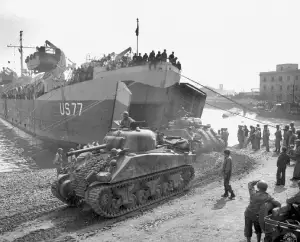
The Anzio Landing Museum was inaugurated on January 22, 1994, on the occasion of the 50th anniversary of the landing, on the initiative of the "Anzio Landing and Battle Research and Documentation Center – ODV" association. It is housed in one of the halls of the historic Villa Adele, dating back to the 17th century, located a short distance from the train station and the city center.
It is divided into four sections dedicated to the main forces that faced each other at Anzio: the American, British, German, and Italian sections. Each section hosts uniforms, weapons, decorations, documents, battle plans, photographs of veterans, and everyday objects, all strictly authentic.
It also has a photographic archive, a tape library, a library, and a press library. The collection is further enriched with flags, period prints, motor vehicles, and other artifacts, with continuous expansions made possible by donations from other museums, veteran associations, and private citizens of the nations involved in the conflict.
Numerous artifacts come from the seabed off Anzio, where planes, landing craft, warships, and cargo ships, often sunk with most of their crew, are still found at various depths. Among these, the British destroyer Janus (sunk with 158 men), the cruiser Spartan (with 46 men killed and 42 wounded), and the hospital ship St. David (sunk with 57 men and 2 nurses, despite being clearly marked with the red cross and protected by the Geneva Convention) are particularly noteworthy.
The Anzio landing (code-named Operation Shingle) was a military landing operation conducted by the Allies on the Tyrrhenian coast opposite the towns of Anzio and Nettuno during the Italian Campaign in World War II. The objective of this maneuver was to create a beachhead at Anzio beyond the German deployment on the Gustav Line, in order to outflank it and force the opponents to divert large forces from the Cassino front, thus allowing the breakthrough of the 5th Army under General Mark Clark along the Tyrrhenian sector of the Gustav Line. Simultaneously, the troops landed at Anzio would occupy the Alban Hills, preventing the retreat of the German divisions: their destruction would allow the capture of Rome and shorten the campaign.
The landing was successful on January 22, 1944, carried out by the US VI Corps, led by Major General John Lucas; but overall, Operation Shingle did not achieve its initial goals. The German forces under the command of Field Marshal Albert Kesselring, despite the initial surprise, managed to block the initial advance of the VI Corps and launch a series of counterattacks, which seriously challenged the Anglo-Americans and cost them heavy losses. The long and exhausting battle of position that followed in the beachhead area continued until the following spring, when the Germans were forced to retreat after the collapse of the Cassino front. In this case too, however, the main objective, namely the destruction of the German forces in Italy, was not achieved and the retreating Germans were able to escape the enemy trap and redeploy on the Gothic Line, a bulwark that engaged the Anglo-Americans in the Apennines for months.